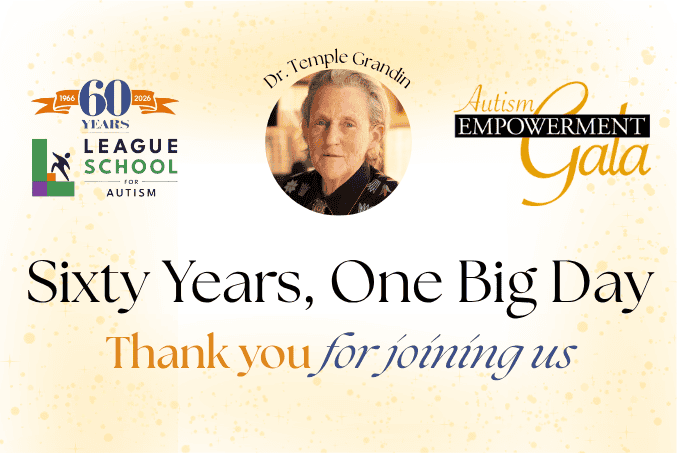
Sixty Years, One Big Day: Temple Grandin at League School
Friday, October 16 was a full day at League School for Autism. It started with a visit from Dr. Temple Grandin.
A morning on campus
Dr. Grandin started her day with a tour of the League School. She met our senior leadership team and our staff, and she spent time with our students. They were excited to see her, and made a custom piece of artwork to say thank you for spending the morning with them.
The stop that stood out was our catering kitchen. Students already work there, learning to cook and to clean the way a restaurant kitchen requires. Those are skills they can take straight into a job. Dr. Grandin was impressed. She has spent years arguing that autistic people learn best by doing, and that real work builds real skills, so it meant a lot to see that idea in use on our campus.
We also showed her renderings of the Career Learning Center and told her that her work and advocacy for training autistic people in hands-on, skilled jobs helped inspire it. The CLC will become a fully vocational trade school for League School students, with a greenhouse, a café, a skilled trades shop, a technology lab, and an office skills room. Job coaches will work alongside students as they learn employable skills. Students will learn a trade, practice it, and leave ready to work. Construction is set to begin this fall.
The Speaker Spotlight
More than 175 people filled the Four Points Sheraton in Norwood that afternoon to hear her speak. Her message was practical. Autistic people often have strong skills in specific areas, and employers should hire them. Picture thinkers can do well in design and the skilled trades. Pattern thinkers can do well in math, engineering, and programming. She pointed to a shortage of electricians, plumbers, mechanics, and welders, steady jobs for people who can build and fix things. To get students there, she wants shop, art, and sewing classes back in schools and young people working real jobs early.
The Autism Empowerment Gala
That evening, we celebrated our 60th anniversary at the Autism Empowerment Gala.
League School began in 1966, when parents and educators opened one classroom in the basement of the Peabody School in Newton. Doctors had been describing autism in medical literature for only about twenty years. Dr. Leo Kanner first wrote about it in 1943 after studying eleven children. Many families were told nothing could be done, or that they were to blame, and many children were sent to institutions. Our founders, Leona and Arnold Vetstein and Morton and Russela Olin, believed their children could learn. Dr. Carl Fenichel, who founded the League School of Brooklyn, helped them get started. Federal law did not guarantee children with disabilities a public education until 1975.
The school moved five times. It went up the hill to the Old Richardson House, to the Lindemann Mental Health Center in Boston in 1973, back to Newton in 1981, and to a 12-acre campus in Walpole in 2000. Between 2015 and 2019, we added a three-story wing and two residential buildings. Today we serve 110 students ages 3 to 22, 32 of whom live on campus, from more than 60 communities.
We honored Dr. Grandin with the Vetstein Impact Award. Nancy Vetstein Hershfield, daughter of our founders, received the Lockwood Directors Award. The Christopher Catanese Children’s Foundation received the Community Leadership Award for its support, including our Music and Art rooms. Bob Murphy received the Dr. Frank Gagliardi Employee Award after 35 years of steady, calming support for students and staff.
The Doug Flutie Jr. Foundation’s Spectrum of Sound joined the League School Choir for a mashup of: “Stand by Me,” “Somewhere Over the Rainbow,” “We Are Young,” and ” O-o-h Child.” Harrison Stebbins kept the room moving as emcee and auctioneer, and we raised more than $250,000 for the Autism Empowerment Fund.
We also shared plans for the Career Learning Center, which will help every student prepared to enter the community with a vocational skill. It was a night to celebrate 60 years of impact on autistic lives and to help families see a better future.
